Will a Dumpster Damage My Driveway? What We Put Under It
What a full 14 yard dumpster weighs, why contact area matters more than weight, and how we set it on concrete, asphalt and pavers in Central Florida.
Read the guideMost of what a house or a renovation throws off can go straight into a roll off dumpster. Florida law draws a hard line around a short list, and the two counties we work in, Orange and Seminole, run the programs that take that list off your hands. Here is how we sort it at Eco Haul Services, with the rule behind each answer.
The short version first. Furniture, drywall, lumber, shingles, tile, carpet, cabinets, yard waste and bagged household junk go in. Whole tires, car batteries, appliances with a compressor, paint, chemicals, propane tanks and anything that leaks or burns stay out, and so does concrete, by our own rule rather than the law’s. That is not us being picky. Florida statute 403.717 says whole waste tires may not be deposited in a landfill, and statute 403.708 does the same for lead-acid batteries, used oil and large appliances. The landfill scale does not care what the item is called, so weight is the other rule.
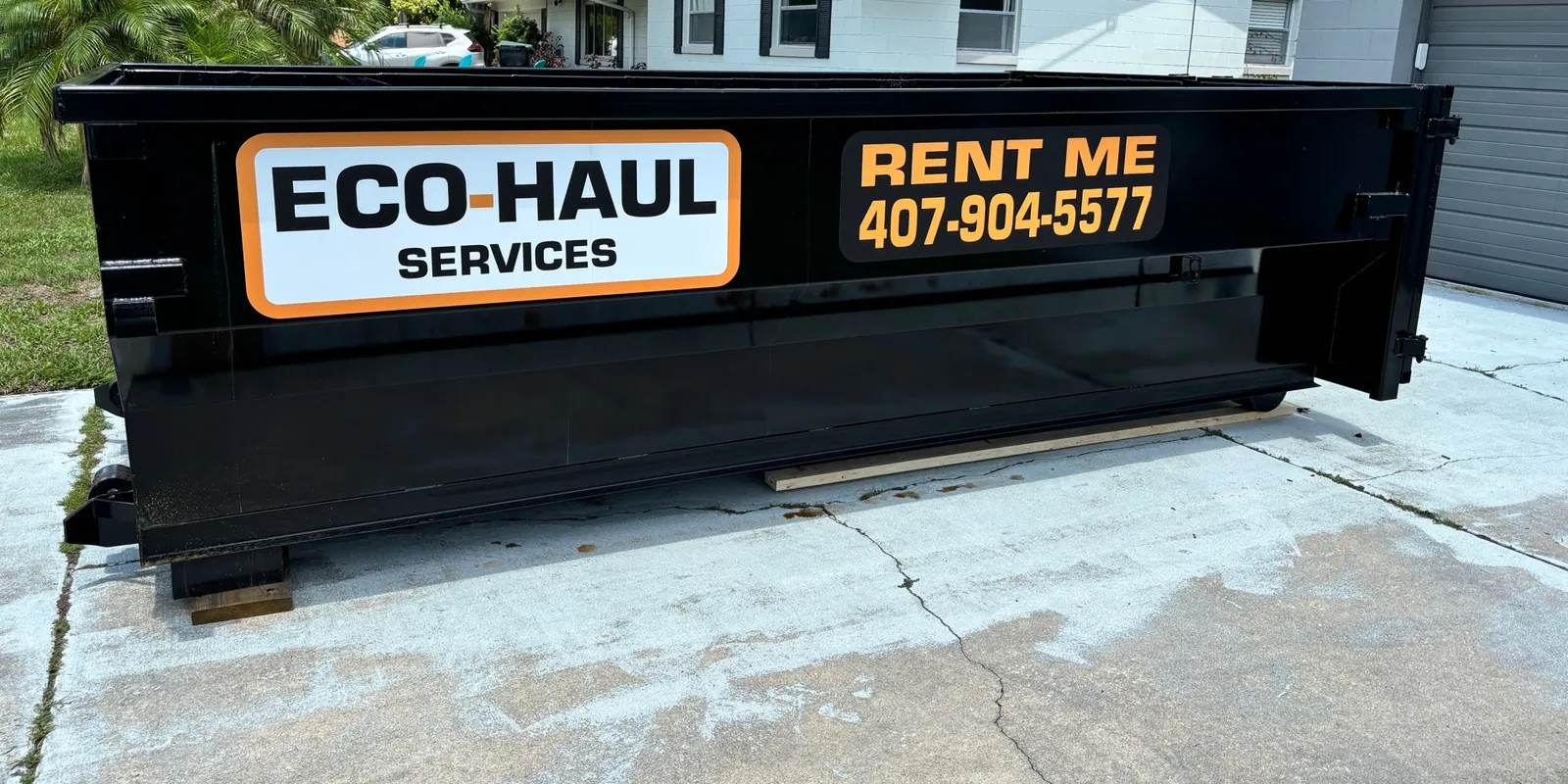
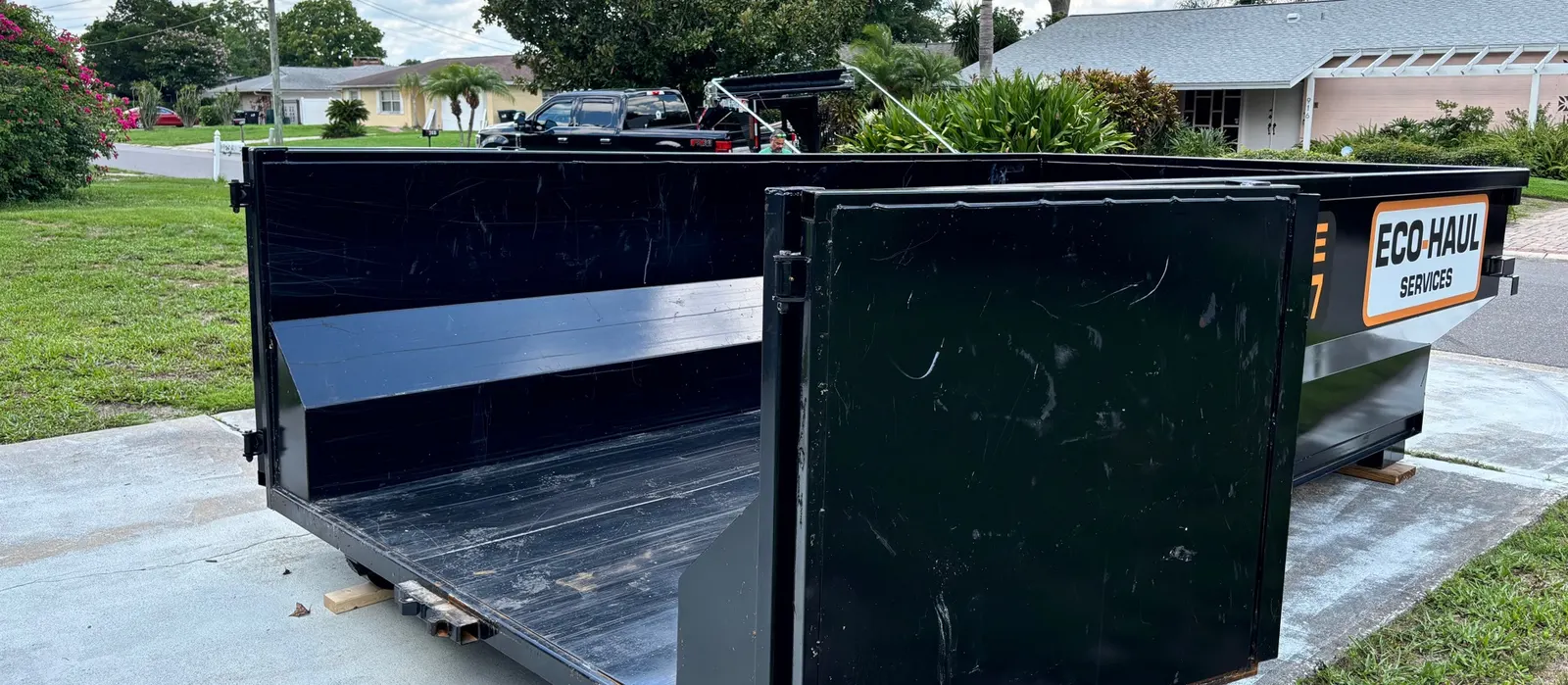
Our 14 yard dumpster is built for exactly this list. Load it over the 4 foot side and keep the pile below the rim so the tarp fits, because every load that leaves in it goes out under one.
Three of those lines share an asterisk: roofing, tile, dirt and wet yard waste are heavy, and every plan includes a set amount of disposal weight, one ton on most plans and two on the 7 day plan. We cover how far each plan goes in its own guide.
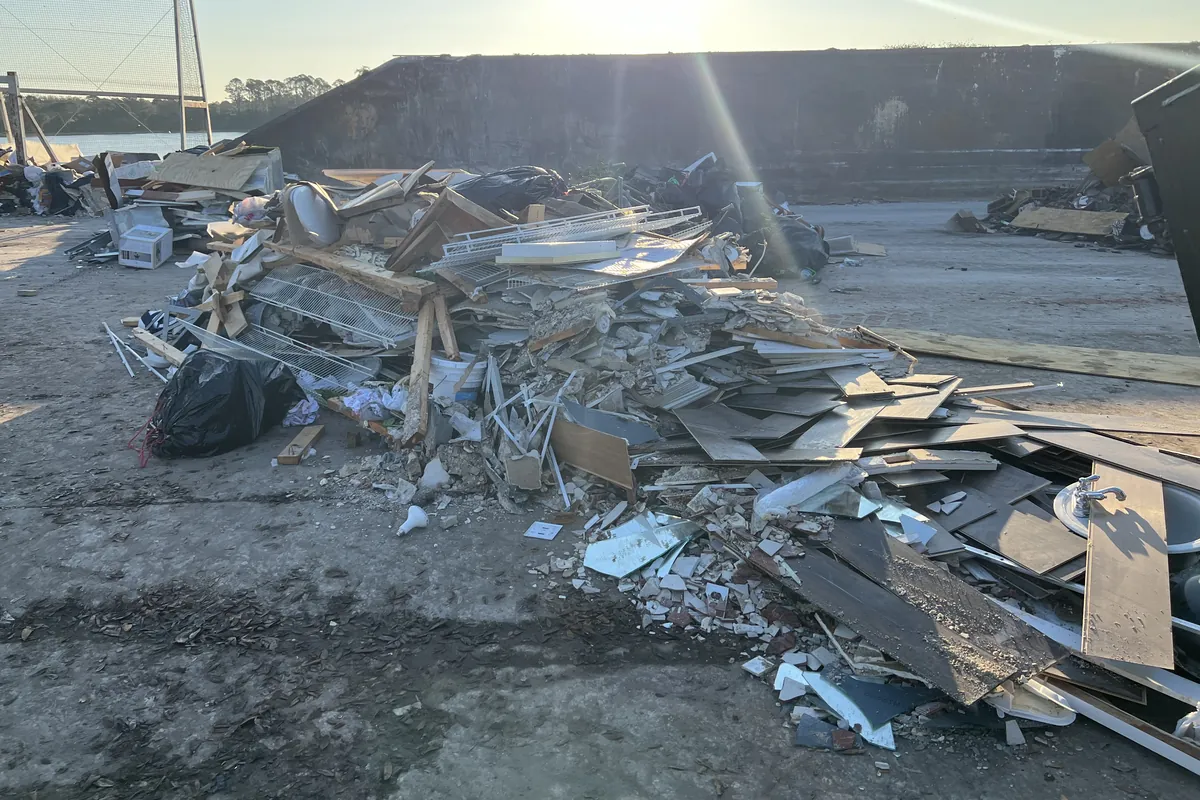
The national dumpster guides skip this part because it changes state by state. In Florida the list is short and written into Chapter 403 of the state statutes.
Tires. Statute 403.717 states that whole waste tires may not be deposited in a landfill as a method of ultimate disposal, and that disposing of waste tires anywhere except a permitted solid waste management facility is unlawful. So a tire in the dumpster is a tire we have to pull out. The Orange County Landfill on Young Pine Road takes passenger tires for $2.00 each, up to eight at a time, and Seminole County takes passenger tires at its Longwood transfer station for $3.16 each, with a limit of four per person, or ten per person at its Osceola Road landfill.
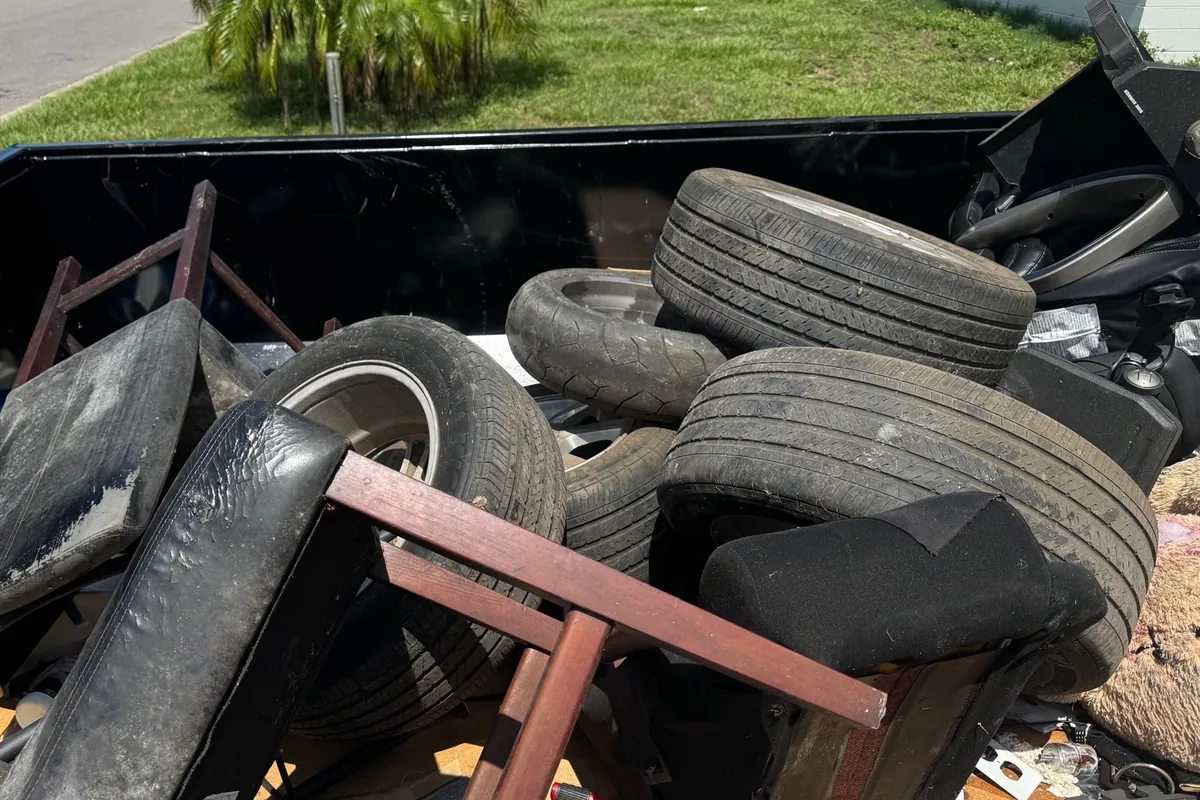
Lead-acid batteries. Statute 403.708(12) says a person who knows or should know the nature of a lead-acid battery may not dispose of it in a landfill, and adds that it may not go to a waste-to-energy plant either. The same law obliges any retailer that sells car batteries to take the old one back as a trade-in. The auto parts store is the right destination, not the container.
Large appliances, which the statute calls white goods. The same subsection bans white goods from landfills, and statute 403.703 defines them as discarded air conditioners, heaters, refrigerators, ranges, water heaters, freezers, and other similar domestic and commercial large appliances. These get recycled as scrap metal instead of buried. Refrigerators, freezers and window units carry a second rule on top, a federal one. Under EPA Section 608 the refrigerant has to be recovered before the appliance is scrapped, with equipment that meets EPA’s performance standards, and the scrap yard or landfill has to hold a signed statement saying who recovered it and when. EPA does not require the person recovering it from a household fridge, freezer or window unit to be a certified technician, but the recovery itself is not optional. That is why an old fridge is a job for our crew, not for the dumpster.
Used oil. Also on the 403.708 list. Motor oil, hydraulic fluid and the like go to the county program described below, or back to any shop that accepts used oil.
Yard trash, with a twist. Florida restricts yard trash at lined Class I landfills unless the landfill captures its gas and puts it to use. In practice yard waste travels to its own facility, and that is why the counties want it kept separate. Orange County charges mixed loads at the higher tonnage rate, and its yard waste rate ($46.80 per ton) is different from its construction debris rate ($41.10 per ton) and its garbage rate ($54.20 per ton). A dumpster that mixes branches with drywall is a dumpster that costs more to empty.
Paint, solvents, pesticides, pool chemicals, propane, fluorescent bulbs and electronics are what people most want to throw into a dumpster at the end of a cleanout, and what we most need to keep out. Both counties have a free program for residents.
Orange County runs household hazardous waste collection at the Orange County Landfill, 5901 Young Pine Road, and at the Porter Transfer Station, 1326 Good Homes Road, Monday through Saturday from 8 a.m. to 5 p.m. The program accepts paint products, pesticides, propane tanks, cooking oil, fluorescent bulbs, automotive fluids, rechargeable batteries, cleaning fluids and pool chemicals, plus electronics with circuit boards. There are limits to know before you load the car. Paint and chemicals are capped at 25 gallons per vehicle. Propane tanks up to 20 pounds go to the transfer station or a community event, and tanks up to 100 pounds go to the landfill. The county will not take pressurized cylinders other than propane, ammunition, fireworks, flares, prescription drugs, rear-projection televisions or tires at the hazardous waste site.
Seminole County takes household hazardous waste from all county residents, including people who live inside its cities, at the Central Transfer Station, 1950 State Road 419 in Longwood, Monday through Saturday from 8 a.m. to 5 p.m., at no cost. Paint, batteries, fluorescent bulbs, electronics and propane tanks are all on the free list. Tires are taken at the same site but are not free, $3.16 each and four per person. Businesses are not allowed to use the program. The county landfill is at 1930 Osceola Road in Geneva.
If an estate cleanout leaves you with thirty years of half-used cans, one trip to one of these sites solves it, and we will point you to the right one for your ZIP code.
Some items are legal to landfill and still worth a call.
Mattresses and box springs. No Florida statute bans them, but they do not compress well, they take up a lot of space at the transfer station, and many haulers restrict them for that reason. Tell us before you load one. If the pile is mostly furniture and mattresses, our junk removal crew is usually the cheaper tool anyway, because you are paying for volume.
Televisions and electronics. Legal, but we would rather they went to the county program, which takes them free and keeps the lead and the circuit boards out of the ground. The one piece of electronics Orange County’s program turns away is the rear-projection TV, and the county tells you to set it out for large item curbside pickup instead.
Dirt, concrete and rock. Legal, and the question is weight. Concrete is the one material on this page that the law allows and we still do not take, a broken driveway or slab included. Dirt and rock are heavy too, so tell us before you load them and we will tell you what it means for your plan.
Treated lumber and railroad ties. Old fence posts and deck boards are fine. Railroad ties are treated with creosote, and Florida’s solid waste rule says wood carrying creosote is not clean wood, so a tie never belongs in a mulch or a clean wood pile. Neither county’s household hazardous waste program lists them among what it accepts, and EPA tells homeowners that creosote treated wood usually goes out as ordinary municipal solid waste, which here means a lined landfill. Tell us before you load a stack of them and we will route them.
The pattern is the same every time. If it is bulky and inert, it goes in. If it is chemical, pressurized or built around a motor, it goes somewhere with a program for it.
Here is the number that decides more dumpster bills than any list of prohibited items. One cubic yard of broken concrete, roofing tear-off or soaked palm fronds weighs a great deal more than a cubic yard of cabinets and cardboard, and the landfill weighs the container on the way in.
Every Eco Haul plan includes disposal weight, one ton on the 1, 3 and 30 day plans and two tons on the 7 day plan, which is the one most people book for anything involving a contractor. Weight over the included amount is $0.05 per pound, $100 a ton, and we never haul the container over four tons. We say it on the phone when the project sounds heavy, before the job and not on the invoice. If you tell us “we are breaking up the patio,” the answer is that the concrete does not go in the container.
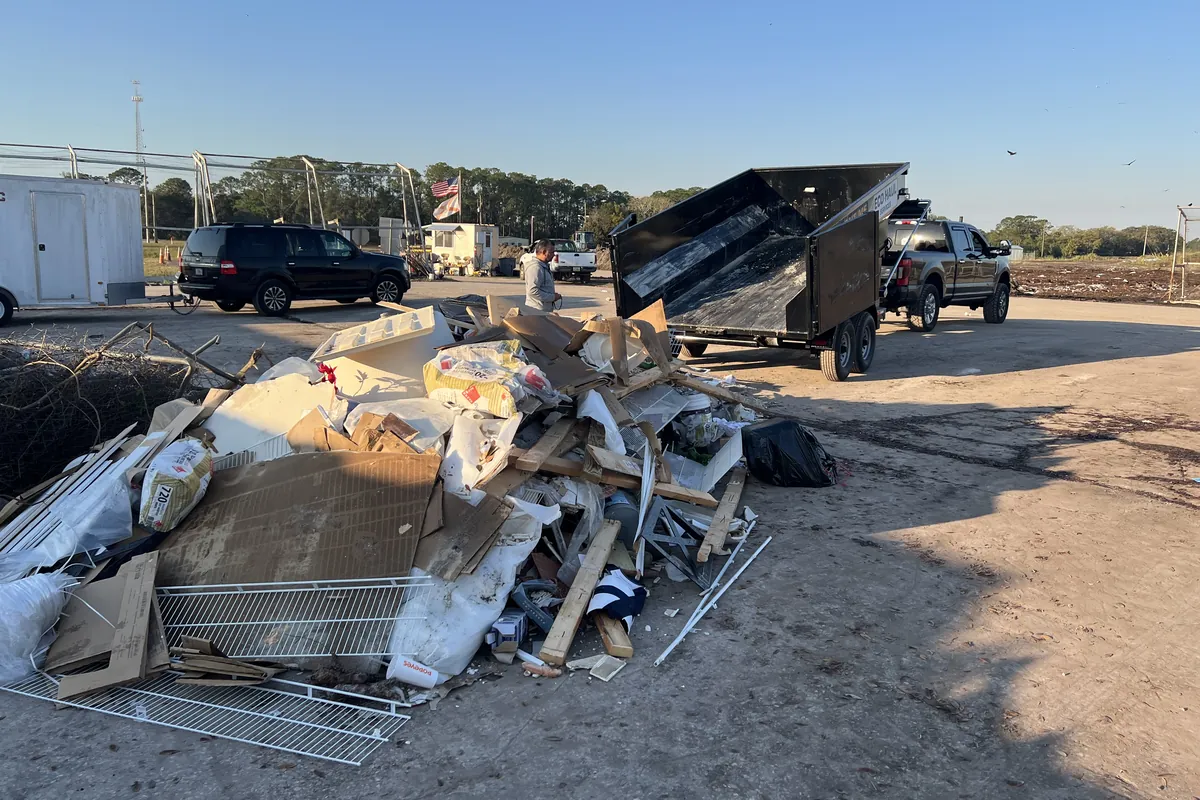
The practical routes, in the order we use them on our own jobs:
The rest is a two minute call, and we will always tell you before you book, not after.
Ready to order a container, or not sure whether your pile belongs in a dumpster or on our truck? Check pricing or call (407) 904-5577 and describe the job. We will tell you straight, even when the answer is the cheaper service.
Eco Haul Services rents dumpsters and hauls junk in Winter Park, Orlando and 22 other Central Florida communities. Rules and fees above are the counties’ and the state’s, checked in September 2026. Orange County’s rates took effect October 1, 2025 and Seminole County’s on September 25, 2024; check the linked pages for changes.
Florida does not ban mattresses from landfills, but they do not compress well, they take up a lot of space at the transfer station, and many haulers restrict them for that reason. Tell us before you load one. If the pile is mostly furniture and mattresses, our junk removal crew is usually the cheaper tool anyway.
We would rather you did not. Orange County and Seminole County both take televisions and other electronics from residents at their household hazardous waste sites at no charge, which keeps the lead and the circuit boards out of the landfill. The one exception is rear-projection TVs, which Orange County's program does not accept and tells you to set out for large item curbside pickup instead.
Whole tires, lead-acid batteries, used oil and large appliances are banned from Florida landfills by state statute, and anything hazardous, such as paint, solvents, pool chemicals, propane tanks and fluorescent bulbs, goes to the county's household hazardous waste program instead. Refrigerators, freezers and air conditioners also need their refrigerant recovered with EPA approved equipment before disposal, and whoever scraps them has to hold a signed statement saying who recovered it and when.
Yes, and after a storm that is one of the most common loads we haul. Keep it in its own container or its own pile if you can, because Florida limits where yard trash can be landfilled and Orange County charges mixed loads at the higher rate. Wet branches and palm fronds are also heavier than they look, so they eat into the disposal weight your plan includes.
Florida law does not ban concrete, brick, tile or dirt from a dumpster. Our 14 yard container is stricter than the law: we do not take concrete, a broken up driveway or slab included. Two or three cubic yards of it already weigh a ton, and we do not haul this container over four. Brick, block and dirt can go in if you tell us first, and weight over the disposal weight your plan includes is $0.05 per pound.
Keep reading
What a full 14 yard dumpster weighs, why contact area matters more than weight, and how we set it on concrete, asphalt and pavers in Central Florida.
Read the guideFour plans from $295 with delivery, pickup and a ton of disposal included, plus what the Orlando landfill and the city permit really charge, with sources.
Read the guideWhat a ton of concrete, drywall or household junk looks like in a 14 yard dumpster, with EPA and Florida factors and how the Orlando landfill weighs it.
Read the guideTell us what you have and where you are. We will come back with a price, not a runaround.