Will a Dumpster Damage My Driveway? What We Put Under It
What a full 14 yard dumpster weighs, why contact area matters more than weight, and how we set it on concrete, asphalt and pavers in Central Florida.
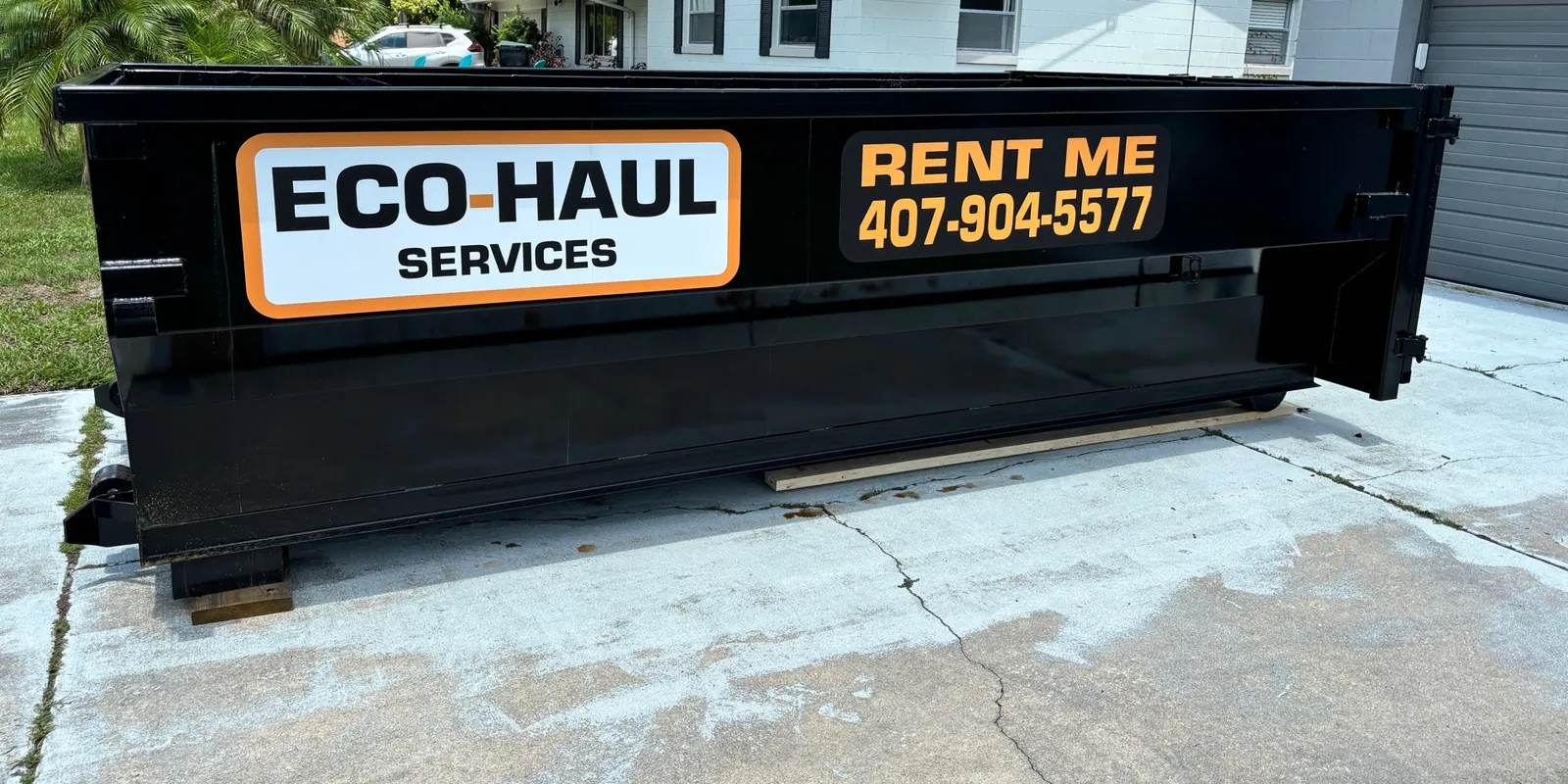
Read the guideEvery Eco Haul dumpster plan includes disposal weight, one ton on the 1, 3 and 30 day plans and two tons on the 7 day plan, and the most useful thing we can tell you is what it looks like in the container. Full of ordinary household junk, our 14 yard box weighs between 1.75 and 2.1 tons by the EPA’s own conversion factor, which puts a full garage cleanout right at the two tons of the 7 day plan. Full of mixed construction debris it weighs about 3.4 tons, using the average that the University of Florida measured on 171 real loads in this state. And broken concrete reaches a ton at 2.3 cubic yards, with more than four fifths of the container still empty. Concrete does not go in our container at all.
The rest is that arithmetic, material by material, starting with whether the container itself counts.
No. The scale at the landfill weighs the truck with the loaded container on the way in and the truck with the empty container on the way out, and the difference is your load. Seminole County’s fee resolution says it plainly, “loads of garbage, trash, yard waste, and other wastes will be weighed and the following disposal fees charged,” per ton, and it only falls back on “computer stored average weights if the net weight of any vehicle cannot be determined,” in which case the fee is assessed at the full capacity of the vehicle. It adds that its truck scales at the landfill and the transfer station are calibrated as permitted by the Florida Department of Agriculture and Consumer Services. Cubic yard rates exist in that resolution too, but only “when the scales are inoperable.”
So the steel is the hauler’s problem. Any estimate you make before loading is exactly that, and the scale house has the final word.
The factors we use come from a seven page memorandum the EPA published in April 2016, “Volume-to-Weight Conversion Factors.” The column that matters is titled “Estimated Weight,” and the memorandum says on its first page that “primary data collection was not performed.” These are averages from other studies, meant for comparing recycling rates, not a promise about your load. The rows that matter for a roll off, in pounds per cubic yard:
| Material (EPA row, shortened) | Pounds per cubic yard |
|---|---|
| Small rock and gravel | 999 |
| Dirt and sand | 929 |
| Concrete, with or without rebar | 860 |
| Asphalt paving | 773 |
| Composition (asphalt) roofing | 731 |
| Mixed yard waste, compacted | 640 |
| Construction and demolition bulk (the Florida figure) | 484 |
| Gypsum board (drywall) | 467 |
| Construction and demolition, mixed remainder | 417 |
| Mixed municipal solid waste, uncompacted | 250 to 300 |
| Leaves | 250 to 500 |
| Mixed yard waste, loose | 250 |
| Dimensional lumber | 169 |
| Carpet | 147 |
| Branches, stumps, prunings | 127 |
Row names are shortened. The memorandum’s own labels are Large and Small Concrete with and without Re-bar, Composition Roofing, Clean Gypsum Board, Clean Dimensional Lumber and Mixed MSW Uncompacted, for residential, institutional and commercial waste together.
There is no row for brick, no row for furniture and no row for mattresses. For the last two, Contra Costa County in California publishes its own official table with “bulky items (mattresses, box springs, sofas, etc.)” at 80 pounds per cubic yard and appliances at 340. And the EPA’s rows for compacted waste inside a landfill, 1,200 pounds per cubic yard and up, describe a buried cell, not a container, so they are the wrong numbers for a dumpster.
The EPA’s figure for mixed construction and demolition debris did not come from a national average. Its source list points to the Florida Department of Environmental Protection for that figure, and the department’s reference is a fact sheet it still publishes for facility operators, written by researchers at the University of Florida, who “measured the weights, in tons, of 171 different loads of C&D debris at 10 facilities in the State.” In the fact sheet’s own words, “the average bulk density was measured to be 484 pounds per cubic yard or approximately 0.24 tons of C&D per cubic yard.”
It was measured on real loads in Florida, at the kind of facilities our loads go to. And it comes with a spread: the 171 loads ranged from under 50 pounds per cubic yard to about 1,600, so a container of mixed renovation debris can weigh a third of the average or three times it, which is why we ask what is going in the box. The study is from 2000, but it remains the factor the state publishes for facilities without a scale and the one the EPA adopted in 2016.
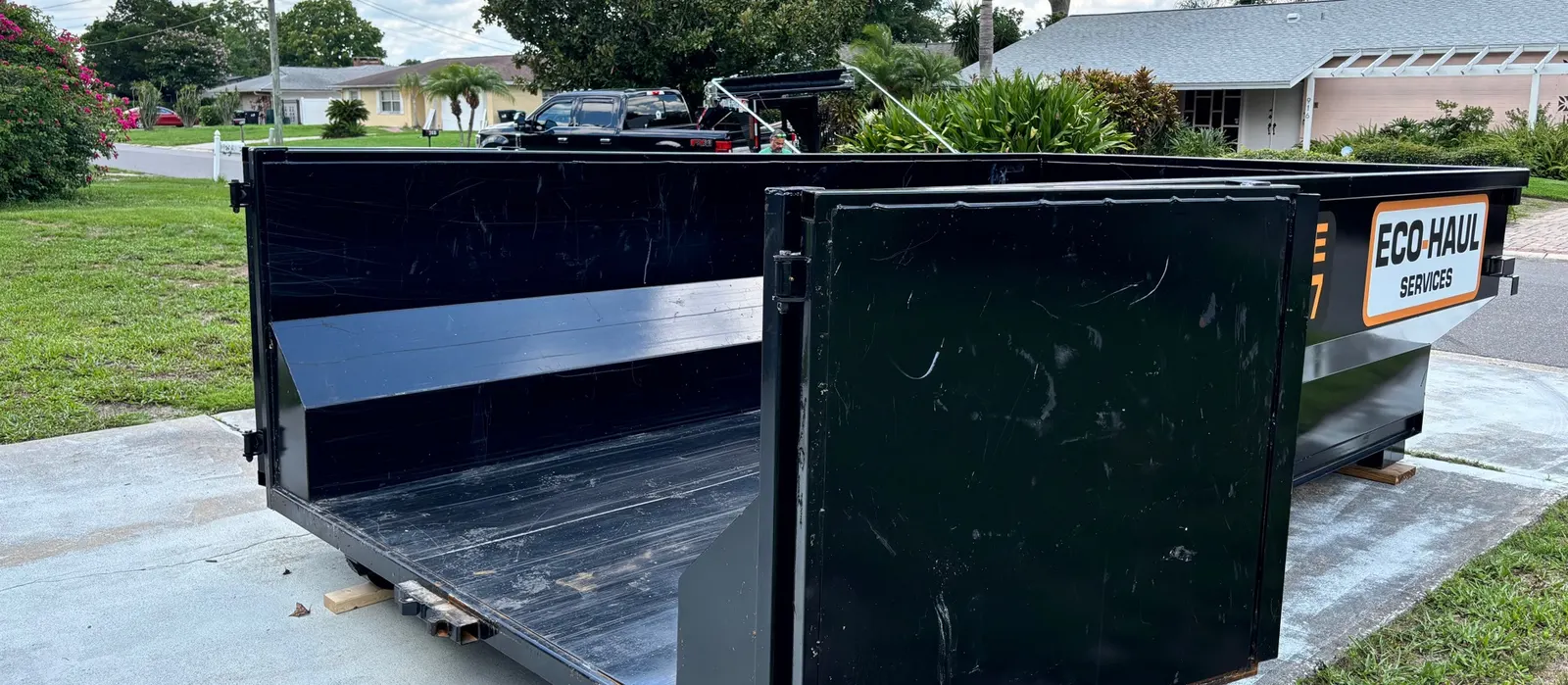
Our container holds 392 cubic feet, about 14.5 cubic yards. We run the arithmetic on a round 14, which understates a full box by about 4 percent. This is how many cubic yards of each material reach 2,000 pounds. It is our arithmetic on published estimates, not a measurement, and your pile will differ.
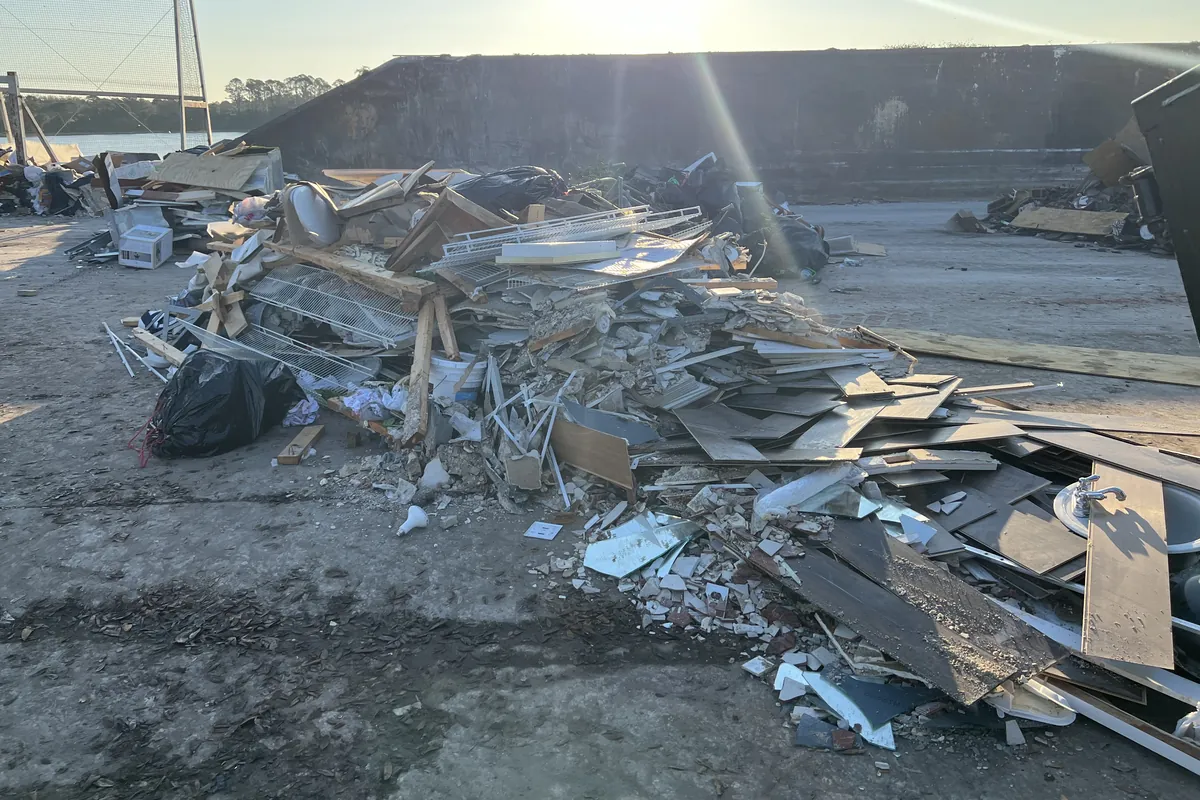
A full 14 yard container of mixed construction debris weighs about 3.4 tons, a full container of household junk between 1.75 and 2.1 tons, and a full container of concrete or dirt six tons or more, three to six times the disposal weight any of our plans include, and past our own limit: we do not haul the container over four tons. One or two dense materials, a load of dirt, a tear off of tile, can change the weight of the container more than everything else in it.
A cubic yard of concrete is 860 pounds on one website and 4,000 on the next, and both are describing something real. Engineering references put solid concrete at roughly 150 pounds per cubic foot, about 4,000 pounds per cubic yard. Florida’s own Department of Transportation tells designers to use “Concrete = 150 pcf” when they calculate the dead load of a structure, and that is the number to use when you measure a slab that is still on the ground. The EPA’s 860 comes from characterizations of construction loads as they arrive at a facility, broken, mixed and full of air between the pieces. A demolished slab takes up far more room in a container than it did in the driveway, so the weight per cubic yard of box goes down.
That is our reading of why the sources disagree, not something the EPA states. Measure the slab on the ground for its weight; the container factor only says the room the pieces take. Neither puts a slab in our container.
Every load we take to the county landfill crosses a scale, and both counties publish what happens there. The Orange County Landfill on Young Pine Road charges $41.10 per ton for construction and demolition debris, $46.80 for yard waste and $54.20 for garbage, rates in effect since October 1, 2025, with a $9.00 minimum. Its rate sheet says “any mixed loads will be charged the higher tonnage rate,” that “uncovered loads will be charged a double fee,” and that a customer who fails to weigh out is charged against the deposit collected.
Seminole County charges $41.63 per ton for covered loads of garbage, construction debris and yard waste, the construction debris at the landfill only, effective September 25, 2024, and $83.25 per ton when the load arrives uncovered.
Those rates are what a hauler pays at the gate, and they are the floor under any overage charge. Ours is $0.05 per pound over the weight your plan includes, $100 a ton, and we never haul the container over four tons. They are also why every load in our container leaves under a tarp, why the pile stays below the rim, and why yard waste and construction debris stay apart. We covered which materials travel together and which do not in its own guide, and what a ton costs at each landfill in the pricing guide.
If the job is a house, a garage, a rental turnover or a storm cleanup of branches and furniture, one ton covers about half the container and two tons take you to the top of it. If the pile is mostly furniture and mattresses you will never see the weight limit, and our junk removal crew may be the cheaper tool anyway, because you are paying for volume.
If the job involves a tile floor, a roof tear off or a pile of fill dirt, the weight arrives long before the box is full, and that is the case to tell us about. A slab or a driveway is a different case: we do not take concrete in the container. For the heavy materials we do take, the answer may be the 7 day plan with its two tons, a shallow layer of heavy material under the light, or a second haul. Weight above the included amount is $0.05 per pound, and our rule is that you hear what it means before you book, not on the invoice.
Tell us what you are loading, and we will tell you which plan fits. Prices for every plan are on the pricing page, or call (407) 904-5577 and describe the project.
Eco Haul Services rents dumpsters and hauls junk in Winter Park, Orlando and 22 other Central Florida communities. The conversion factors above are published estimates, and the arithmetic on our 14 yard container is ours; the landfill scale decides the actual weight. County rates checked in September 2026: Orange County’s took effect October 1, 2025 and Seminole County’s on September 25, 2024.
It depends entirely on the material. The EPA's conversion table puts a cubic yard of concrete from a demolition load at about 860 pounds, drywall at 467, dimensional lumber at 169 and ordinary uncompacted household waste at 250 to 300, and a Florida study of real mixed construction loads measured an average of 484 pounds per cubic yard. All of those are estimates, which is why the landfill weighs the container instead of measuring it.
A ton is 2,000 pounds. By the EPA factor for uncompacted household waste, that is roughly seven to eight cubic yards of ordinary junk, or about half of our 14 yard container. By the same table it is only about 2.3 cubic yards of broken concrete or 2.2 of dirt, which is why heavy materials use up the included weight long before the box looks full.
Estimate the cubic yards of each material, multiply by a published pounds per cubic yard factor, and divide by 2,000. For mixed construction debris the Florida Department of Environmental Protection publishes 0.24 tons per cubic yard, measured on 171 real loads in the state. Treat the result as an estimate and tell us what you are loading, because the scale at the landfill has the final word.
No. The landfill weighs the truck with the loaded container on the way in and the truck with the empty container on the way out, and the difference is your load. Orange County and Seminole County both charge by that net weight, and Seminole's fee resolution says its truck scales are calibrated as permitted by the state.
Full of ordinary household junk, our 14 yard container weighs between 1.75 and 2.1 tons by the EPA factor, which puts a full box right at the two tons of the 7 day plan. Full of mixed construction debris at Florida's measured average it weighs about 3.4 tons, and full of concrete or dirt it would weigh six or more. Concrete does not go in our container, and we never haul it over four tons. Every plan includes one ton, the 7 day plan two, weight above that is $0.05 per pound, and we tell you before the job what your material means for that.
Keep reading
What a full 14 yard dumpster weighs, why contact area matters more than weight, and how we set it on concrete, asphalt and pavers in Central Florida.
Read the guideFour plans from $295 with delivery, pickup and a ton of disposal included, plus what the Orlando landfill and the city permit really charge, with sources.
Read the guideThe plain list for Central Florida: what goes in our 14 yard dumpster, what state law keeps out, and where Orange and Seminole County take the rest.
Read the guideTell us what you have and where you are. We will come back with a price, not a runaround.