How Much Does It Cost to Rent a Dumpster in Orlando?
Four plans from $295 with delivery, pickup and a ton of disposal included, plus what the Orlando landfill and the city permit really charge, with sources.
Read the guideA dumpster on a sound driveway, set on boards toward the middle of the slab, should not damage it. The risk with our 14 yard dumpster is not the days it sits there. It is the two minutes it rolls off the trailer, the two minutes it rolls back on, the summer afternoons on asphalt, and the edges, joints and cracks that were already weak before the truck arrived. What goes into our container weighs from 1.75 tons up depending on what you put in it, before the steel box itself, and we do not haul it over four. Where that weight goes is what this guide is about.
We cannot promise a driveway will never mark, and nobody who has delivered a container can. What we can do is explain what the weight really is, what the pavement under it can take, and what we put between the two.
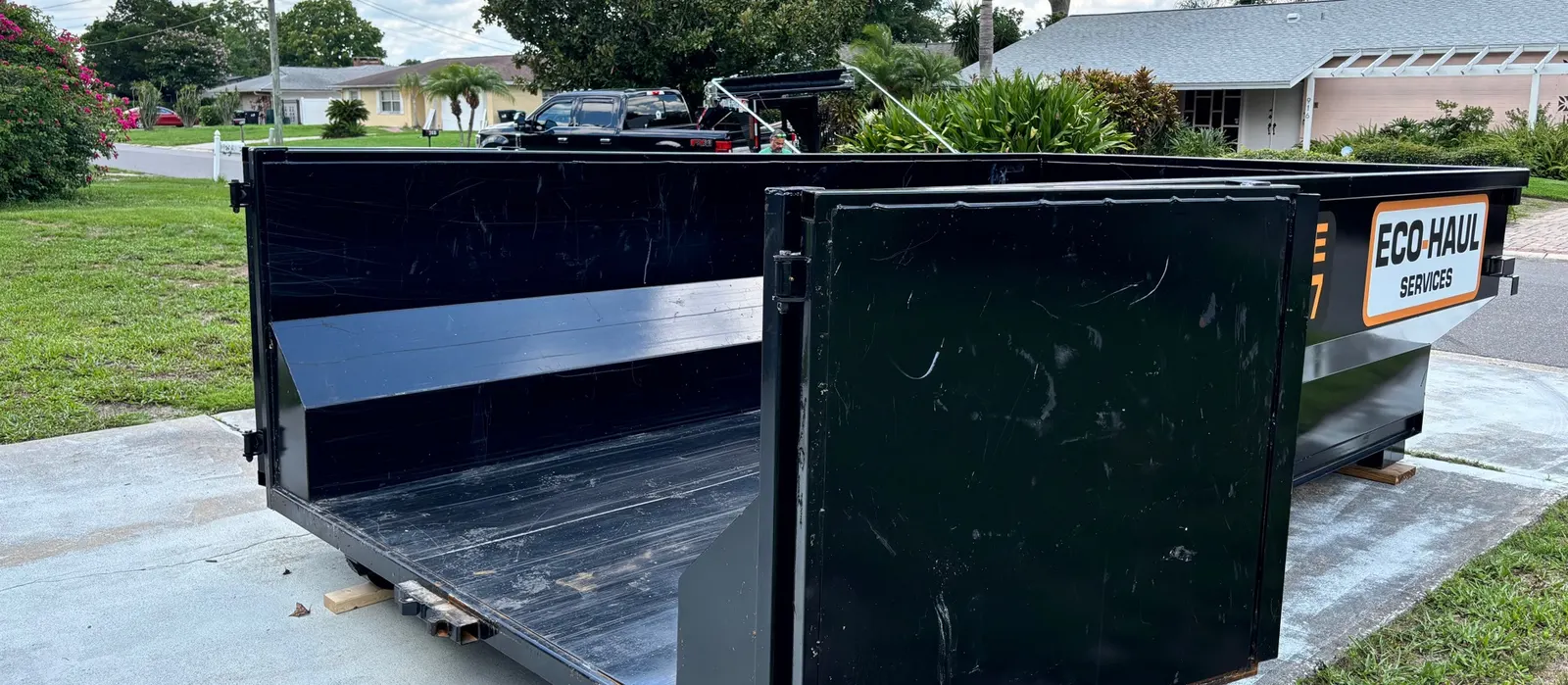
The container is 14 feet long, 7 feet wide and 4 feet high. Empty, it is steel. Full, it is whatever you loaded, and the EPA’s conversion factors put loose household junk at 250 to 300 pounds per cubic yard, mixed construction debris at 484 pounds per cubic yard, a figure the EPA takes from a Florida measurement, and concrete at 860. Fourteen yards of each comes to about 1.75 to 2.1 tons of household junk, 3.4 tons of renovation debris, or 6 tons of concrete, which is why our plans include one or two tons of disposal and why what your load really weighs has its own guide. That last box never rolls off our trailer: we do not take concrete in the container, and we do not haul it over four tons.
So the first honest answer to “how much does it weigh” is “it depends on what is in it.”
A driveway does not feel weight. It feels pressure, which is weight divided by the area it presses on. The container’s footprint is 14 by 7 feet, about 98 square feet, and if six tons of load were spread evenly over that, the pressure would be less than a pound per square inch. Add the steel box, whose weight we have not measured, and it is still a small fraction of what your car’s tires put on the same slab.
The load is not spread evenly. The container sits on its rails and wheels, and that is where the pressure concentrates, especially on asphalt. The Asphalt Institute’s own engineering answer to whether an asphalt surface will dent under a point load is that it depends on the temperature of the mix, the load and how long it is applied, and that when it happens the fix is to put rigid plates under the point load to spread it over a wider area. That is the whole point of the boards you can see under the container in the photo below. They turn a few narrow lines of steel into a wide, flat footprint. We do not publish a pressure figure for the rails, because it would need the empty weight of our container and the width of its rails measured, and we would rather give you no number than a made up one.
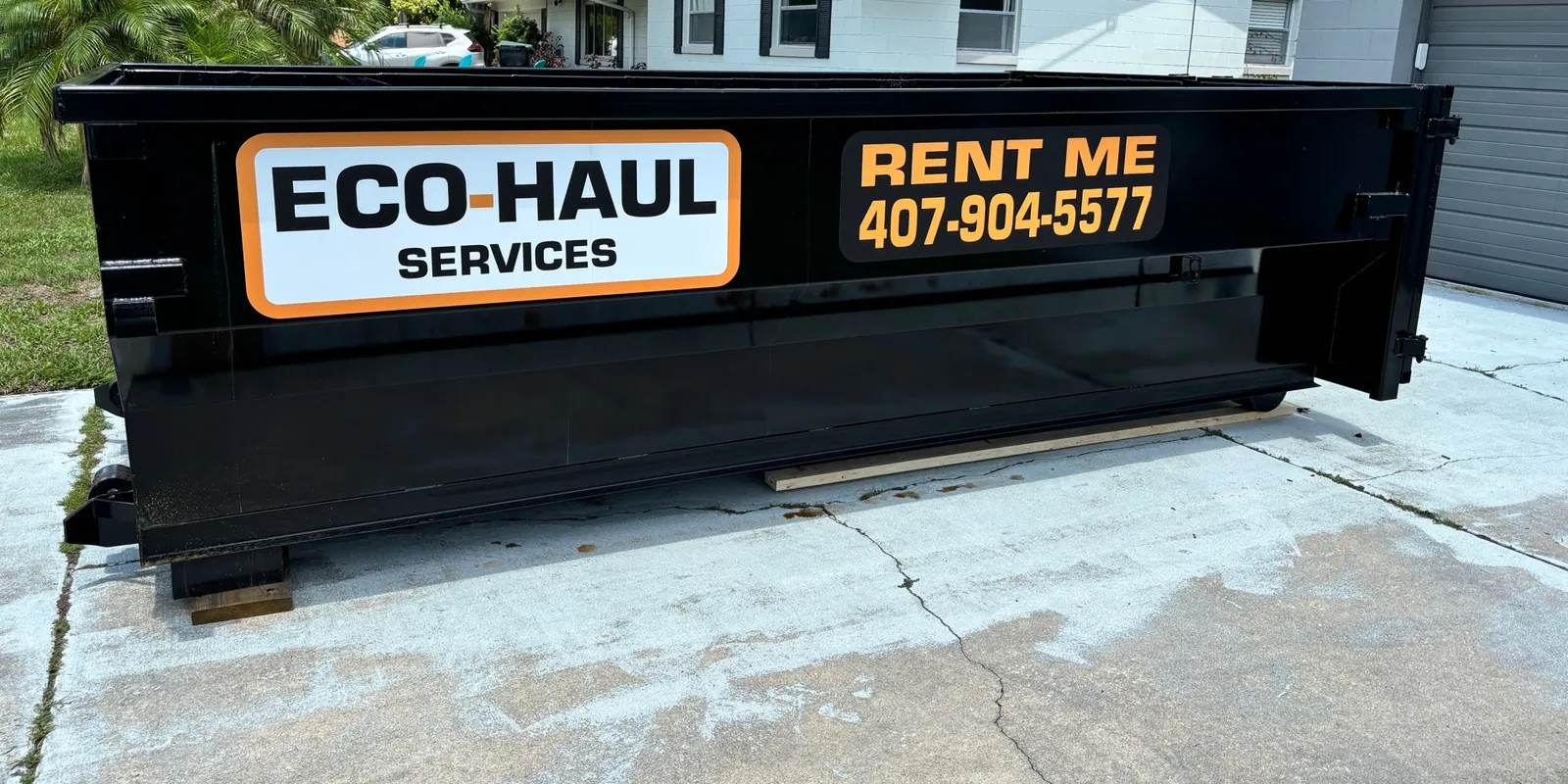
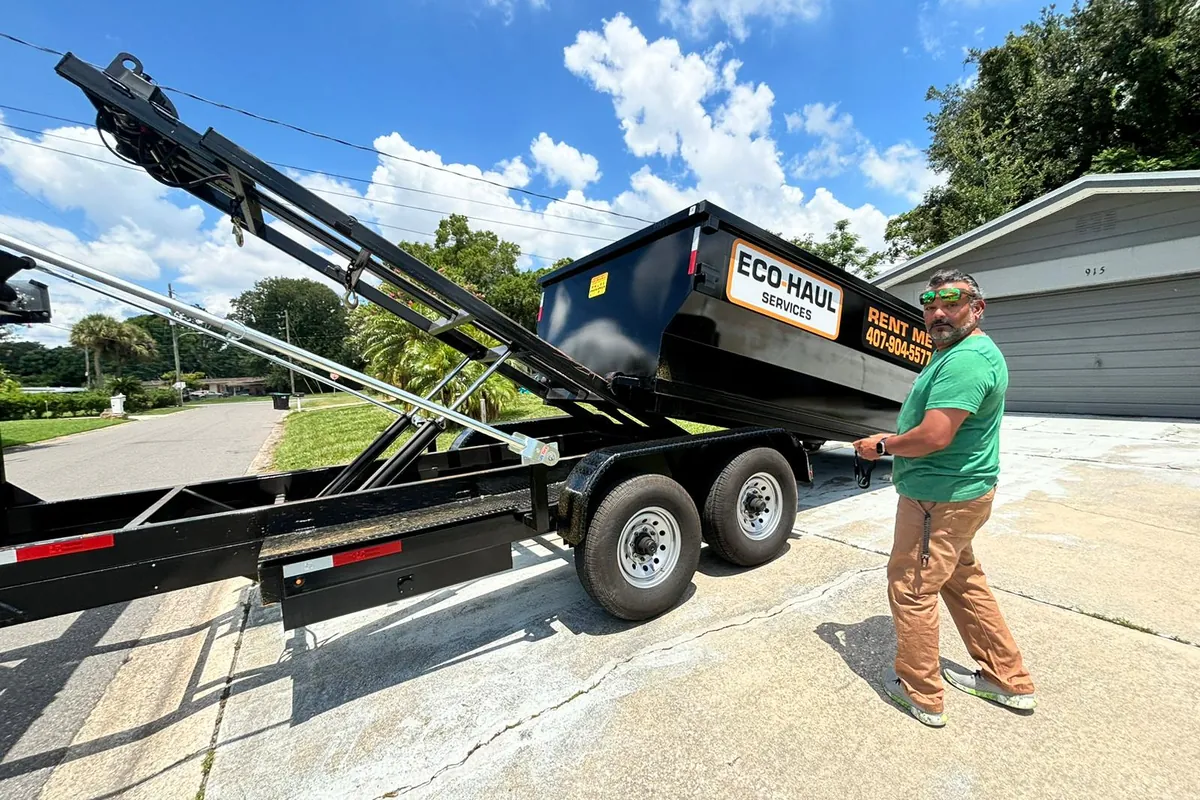
Watch a delivery and you see where the risk lives. The container does not get lowered from above. It comes down off a tilt trailer, rolling on its wheels down the rails, and for those minutes the whole weight of a steel box moves across a small patch of your driveway. On pickup the same thing happens in reverse, except now the box is full, which is when it puts the most weight on the smallest patch.
That is why the driver looks at the spot before anything moves, why the boards matter, and why we ask you a few questions when you book. It is also why we suggest what an experienced customer does: take three photos of the driveway before we arrive. If it is already cracked, you will know, and so will we.
A concrete slab is strongest in its interior and weakest at its edges and corners. The classic analysis of rigid pavements treats those as separate cases, and corner loading is the one that puts the top surface in tension, which is how a corner breaks off. The practical rule for a driveway is simple: the container goes toward the center of the slab, away from the edges, the expansion joints and any crack you can already see, and never straddling the seam where the driveway meets the sidewalk or the garage apron.
Thickness matters more than most people think. The American Concrete Pavement Association’s rule of thumb is that one extra inch of concrete roughly doubles the load a pavement can carry, a rule it states for street and highway slabs of six to twelve inches. A residential driveway is thinner than that, and we could not find a residential driveway thickness published by the concrete industry bodies or the Florida code, so we do not give one. If your driveway was poured recently, ask your contractor how long before it takes a loaded vehicle. Until then, the street.
Asphalt is the surface that changes with the season. Florida’s road specification builds its dense graded mixes around a PG 67-22 binder, the base grade in the state’s own table, and in that grading system the first number is the design high pavement temperature in degrees Celsius. Sixty seven Celsius is about 152 degrees Fahrenheit, the pavement temperature that grade is built to take. The grade is chosen for rutting resistance, and the Texas transportation department’s binder guidance bumps it up for slow or standing traffic, because a load that sits deforms asphalt more than a load that rolls over it.
A dumpster is standing traffic. The asphalt does not melt under it, but on a July afternoon it softens, and a narrow rail resting on soft asphalt for a week can leave a dent. On asphalt, boards under the rails matter most, a morning delivery helps, and fresh sealcoat or new asphalt is a reason to use the street until it cures. Your paving contractor will tell you how long.
Pavers behave differently from a slab. The Interlocking Concrete Pavement Institute’s guide recommends 2 3/8 inch pavers on a six to eight inch base for a residential driveway, and explains that the pavers carry a load by locking together and transferring it through the sand in the joints. That interlock only works while the edges are held in place, which is why the same guide calls edge restraints essential. Load the border and the pavers can spread; load the middle and they hold.
So on pavers the container goes toward the center of the paved area, on boards, never on the edge restraint and never where the pavers meet a concrete apron or the street. If a paver ever does settle, the repair is the one pavers were designed for: lift that piece, level the bedding sand and set the same paver back.
This one is written into the state code, not just good practice. Florida’s onsite sewage code says the site of a septic system and the additional unobstructed land around it shall not be covered with asphalt or concrete or be subject to vehicular traffic, and for mound systems it repeats that no part of the drainfield or its shoulder may carry vehicle traffic. The EPA’s own advice is shorter: do not park or drive on your drainfield, because the weight compacts the soil and can damage the pipes, and a full container sitting on one, like the loaded trailer that brings it, is weight the field was never designed to carry. If your house is on septic, tell us where the tank and the drainfield are when you book. The state health department’s inventory counts about a fifth of Orange County’s parcels and a sixth of Seminole’s as known or likely septic, so the driveway is not always the safe spot.
Our published practice is short: we place the container where you want it and protect the driveway underneath. You do not have to be home for the delivery. What helps is telling us four things when you book. What the driveway is made of. Whether it has cracks, a recent seal or a new pour. Whether the house is on septic and where the field is. And whether the spot you have in mind is on pavers, so the driver aims for the middle.
If none of the spots on your property are good, the street is the other option, with the permit fee if the container has to sit on a public street in the City of Orlando, and no permit fee on your own driveway in Orlando, Winter Park or the unincorporated parts of Orange and Seminole County. One more honest note. Many rental agreements in this business put driveway damage on the customer, which is one reason the questions above matter to us as much as to you. Ask any company you call what its agreement says before the truck comes.
Ready to book, or want a second opinion on the spot? Call (407) 904-5577 or send us a photo of your driveway with the space you have in mind. If the street is the safer choice, we will tell you.
Eco Haul Services delivers dumpsters and hauls junk in Winter Park, Orlando and 22 other Central Florida communities. The pavement guidance above is what the engineering bodies and the state rule say, read in September 2026; every driveway is different, and if yours is new, cracked or on septic, tell us before we deliver.
There is no single number, because a driveway does not feel weight, it feels pressure at the points where the load touches it, and it is weakest at its edges, joints and existing cracks. Loaded, our 14 yard container runs from about 1.75 tons up, plus the steel box itself, and we do not haul it over four. Even six tons spread over its footprint would be less than a pound per square inch, a fraction of the pressure under a car tire. What matters is the rails and wheels it rests on, which is why it goes down on wooden boards, and where on the slab it sits.
On a sound driveway, with the container set on boards toward the middle of the slab, it should not. The moments that carry the risk are the delivery and the pickup, when the container rolls on and off the trailer, and the days a full container sits on hot asphalt in summer. We cannot promise a driveway will never mark, and any company that does is not telling you how the job works.
Our plans run 1, 3, 7 and 30 days, and on sound concrete the length of the stay matters much less than the surface itself, as long as it is not fresh asphalt or new concrete. Longer stays matter more on asphalt in July and August, when the surface softens in the afternoon heat, so for a 30 day project on asphalt we would rather talk about the spot before we deliver.
Pavers spread a load through the sand in their joints, and the interlock holds as long as the edges stay confined, so the weak point is the border, not the middle. The container belongs toward the center of the paver area, never on the edge restraint or where the pavers meet another surface, and on boards. If a paver ever settles, the repair is to lift that piece, level the bedding and put the same paver back, which is one of the reasons pavers are used.
Sometimes yes. If the driveway is fresh asphalt, new concrete, on a septic drainfield, or already cracked where the container would sit, the street can be the safer spot. In the City of Orlando a container on the public right of way needs a permit, the city's fee schedule lists storage containers in the right of way at $50 plus $10 a day, and Permitting Services can confirm that a roll off falls under that line. On your own driveway in Orlando, Winter Park, unincorporated Orange County or unincorporated Seminole County no right of way permit is needed; the cities inside those counties each set their own rules.
Keep reading
Four plans from $295 with delivery, pickup and a ton of disposal included, plus what the Orlando landfill and the city permit really charge, with sources.
Read the guideWhat a ton of concrete, drywall or household junk looks like in a 14 yard dumpster, with EPA and Florida factors and how the Orlando landfill weighs it.
Read the guideThe plain list for Central Florida: what goes in our 14 yard dumpster, what state law keeps out, and where Orange and Seminole County take the rest.
Read the guideTell us what you have and where you are. We will come back with a price, not a runaround.