Cleaning Out a Parent's House in Orlando: Where to Start
The three clocks of an estate cleanout in Central Florida: who has authority, what the law protects, where things go and what our crew and dumpster cost.
Read the guideWhat happens to your junk after our crew loads it comes down to three destinations: donation, recycling, or the disposal facility where the rest is weighed and buried. In Florida, which of the three is not mostly up to the hauler. State law keeps appliances, lead acid batteries, used oil and tires out of landfills whoever brings them, the market decides whether a material is worth recovering, and your county decides what it takes for free. Florida’s legal goal, set for the year 2020, is to recycle at least 75 percent of its municipal solid waste. The state as a whole has held just below 50 percent, and in 2024, by the state’s own count, Orange County reported 32 percent and Seminole County 27 percent.
Florida Statute 403.708 says that anyone who knows or should know what they are throwing away may not put four things in a landfill: lead acid batteries, used oil, yard trash in a lined landfill without gas collection, and white goods. The definition of white goods is broad, discarded air conditioners, heaters, refrigerators, ranges, water heaters, freezers and similar large appliances. A separate section makes it unlawful to dispose of tires anywhere but a permitted facility. Two things people assume are illegal are not. The state’s environmental agency says Florida has no specific laws for discarded electronics and strongly recommends recycling them, and there is no Florida mattress law either.
In 2018, the EPA’s latest count, the country generated 12.1 million tons of furniture and furnishings and recycled 40,000 tons. About a fifth was burned for energy and 80 percent went to landfills. The EPA’s own explanation is that couches, chairs, dressers and bed frames cannot be recycled without significant processing, because of the combination of materials in them.
There is one exit the EPA does not count as recycling: reuse. The agency counts a sofa only when its last owner discards it, so a donated one stays out of the count for years. For furniture, donation is the only route that works, and only while the piece is still in good shape.
Three organizations pick up free in Central Florida, each with its own territory and conditions.
| Who | Picks up free | Conditions |
|---|---|---|
| Habitat for Humanity of Seminole County and Greater Apopka, 407-215-2000 | Seminole County, Greater Apopka and the Orlando area | At least two large pieces, placed outside at ground level, in good condition, accepted at the driver’s discretion |
| West Orange Habitat ReStore, Winter Garden, 407-905-0406 | Large items from homes and businesses in the West Orange area; no published pickup radius | Furniture free of tears, pet damage and stains; working appliances; no used mattresses, box springs or textiles |
| The Salvation Army, satruck.org | By zip code | Unbroken furniture, mattresses, working appliances that are not built in; no gas appliances |
Goodwill of Central Florida takes drop offs but runs its pickups through a partner that charges by the piece, and it does not accept large appliances, mattresses or televisions. Every one of these will refuse a torn or stained piece at the door, which is why a mixed load is where a crew earns its price: it sorts on the spot, and what is still good is set aside for donation instead of going across the scale.
Appliances are the opposite story from furniture. In 2018 the country generated 5.3 million tons of major appliances and recovered 3.1 million tons of ferrous metal from them after shredding, a recycling rate near 60 percent. The reason is physical: by the steel industry’s own figure, about three quarters of the weight of a typical household appliance is steel, which the industry says can be recycled continuously without losing strength, so there is a buyer for it.
A refrigerator or freezer has an extra step. The EPA says almost everything in one can be recycled, and describes the route: the refrigerant is recovered, hazardous parts such as mercury switches, PCBs and compressor oil are removed under federal rules, then the cabinet is shredded and the metal separated. The glass, plastic and foam insulation usually still go to a landfill, and foam is not regulated. In Orange County a fridge cannot go out at the curb, and residents can bring one to the county landfill for the $9.00 minimum; in Seminole County white goods go to the landfill in Geneva, not the transfer station in Longwood. The EPA adds a warning: an appliance left at the curb might be landfilled or disposed of unsafely.
The EPA’s guide on bulky items says up to 75 percent of a mattress is recyclable and that the challenge is finding a recycler, and the mattress industry’s recycling programs operate in California, Connecticut, Oregon and Rhode Island, not here.
Orange County itself points to the exception: its website says to consider recycling a mattress first and names The Mustard Seed of Central Florida, a nonprofit at 12 Mustard Seed Lane in Orlando that has taken apart more than 160,000 mattresses since 2011 and sells the metal, foam, wood and fabric for recycling. It accepts mattresses, box springs and metal frames without rips, stains, tears or odors, dropped off Monday to Friday from 9 a.m. to 3 p.m., and picks them up only when other furniture is donated along with them. A stained or torn mattress is turned away at the Mustard Seed door, and from there the usual route is the scale.
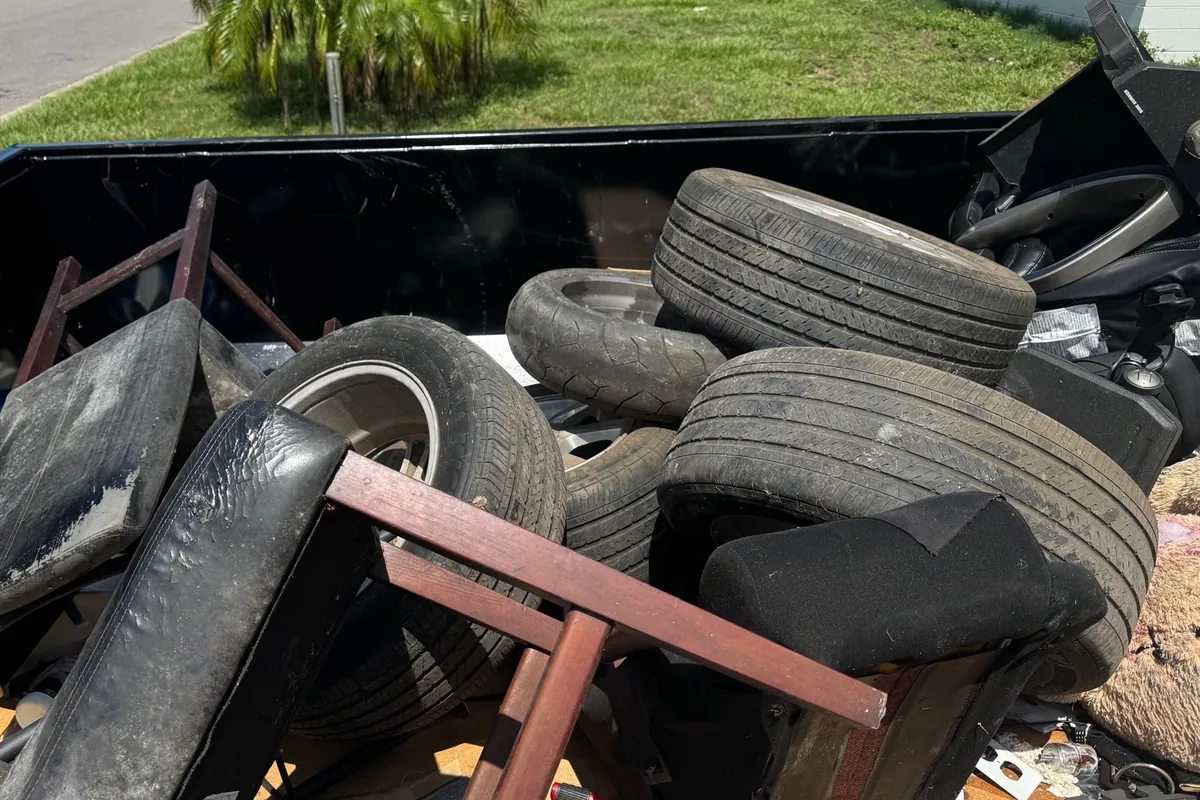
For the household chemicals that need separate handling, the counties run free programs for residents. Orange County takes household hazardous waste and electronics at the Orange County Landfill and the Porter Transfer Station, defines electronic waste as anything with a circuit board, and notes that a rear projection television cannot be recycled and goes out as a large item. Seminole County takes hazardous waste free from every county resident, city addresses included, at the Central Transfer Station in Longwood, and accepts electronics there too. Tires are priced by the piece up to a limit: eight in Orange County at $2.00 each, and $3.16 each in Seminole County, four per person at the transfer station and ten at the landfill.
Both counties say the same thing in different words: no commercial waste, no businesses. Those programs are for the resident who brings their own. A hauler’s truck cannot use those programs at all, which is why paint, chemicals and batteries need separate handling: ask us first and we will guide you, and why what a dumpster can and cannot take has its own list.
Unincorporated Orange County collects large items at the curb on garbage day, up to three cubic yards per household per week, no refrigerators or freezers. Seminole County collects bulk items by appointment through the hauler for your zone. Winter Park residents get two free bulk pickups a year with Waste Pro, in May and in November, on dates the city assigns; outside those windows Waste Pro quotes extra pickups, and in an apartment or condo without curbside service you call Waste Pro at 407-774-0800, where fees may apply. Those limits are the gap a crew fills, and we wrote up the free curb route for a garage so you can decide which is worth your Saturdays.
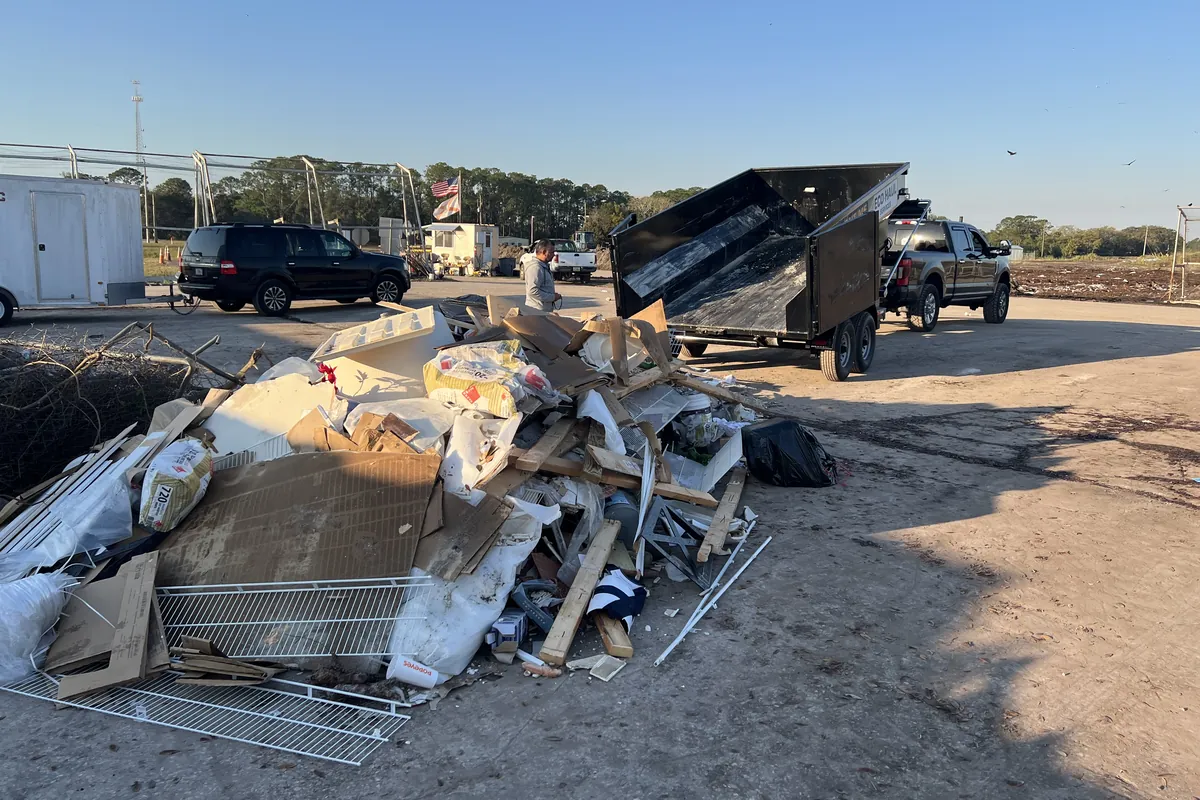
In 2018 the country landfilled about 146 million tons of municipal solid waste, half of everything generated. What a crew changes is the sorting. On our loads the process is the one we publish: we separate what can be donated or recycled before anything goes to the landfill, route appliances, metal and electronics to the proper facility whenever possible, and take the rest to a permitted disposal facility. We do not publish a percentage, because we do not audit our loads, and a number without an audit is a slogan.
Seminole County charges nothing per ton for residential recyclables a resident drives to the transfer station in a non-commercial vehicle, and $41.63 a ton for the same material mixed in as garbage, $83.25 if the load is uncovered. Orange County charges $54.20 a ton for garbage and $41.10 for debris and furniture, double for an uncovered load, and the county says all residential and commercial waste generators are required to recycle, a rule its code spells out for commercial generators in unincorporated Orange County. Where each thing goes, in one table:
| Item | What Florida law says | Orange County | Seminole County |
|---|---|---|---|
| Sofa, dresser, table | Nothing specific | Curb large item, 3 cubic yards a week, or donation | Bulk pickup by appointment, or donation |
| Refrigerator, freezer, A/C | White goods may not be landfilled; refrigerant recovered first | Not at the curb; landfill, $9.00 minimum | Not at the transfer station; landfill in Geneva |
| Mattress | Nothing specific; no state program | Curb large item, or The Mustard Seed if undamaged | Bulk pickup by appointment |
| Television, computer | No state law; recycling recommended | Free drop off for residents; rear projection at the curb | Free drop off at the Central Transfer Station |
| Tires | Only at a permitted facility | $2.00 each at the landfill | $3.16 each |
| Paint, chemicals, batteries | Lead acid batteries and used oil may not be landfilled | Free drop off for residents; no commercial waste | Free drop off for residents; no businesses |
How the price is measured explains what those per ton rates do to a quote, and an estate cleanout is where all of this happens at once.
Have a load with some of everything in it? Call (407) 904-5577 or send us a photo, and we will tell you what can be donated, what the county takes free, what we haul and what it costs.
Eco Haul Services hauls junk and rents dumpsters in Winter Park, Orlando and 22 other Central Florida communities. The laws, county programs and charity policies above are theirs, read in September 2026; confirm on the linked pages before you drive.
Three things, in this order when it can be done: donate what still works, send the metal and the recyclable materials to the facilities that take them, and deliver the rest to a permitted disposal facility, where it is weighed and charged by the ton. Florida law takes some of the choice away: appliances, lead acid batteries, used oil and tires cannot go in a landfill no matter who hauls them. What we can promise is the process, not a percentage: we do not audit our loads, and a diversion rate with no audit behind it is worth what it costs to type.
If the furniture is in good shape and you can wait for an appointment, donate it directly: Habitat for Humanity of Seminole County and Greater Apopka, the West Orange Habitat ReStore and the Salvation Army all pick up free in parts of Central Florida, each with its own territory and conditions. If it is a mix of usable and broken, or there is a fridge, a mattress and a garage of boxes, a crew sorts it in one visit and the usable part still gets donated. The charities will refuse damaged items at the door, so a torn sofa is a junk removal job either way.
The county says it plainly: Orange County's blue cart takes only plastic bottles and containers, cans, glass bottles, cardboard and paper, and Seminole County's bin says not to include clothing, furniture, carpet, bagged recyclables or plastic bags. The EPA adds the consequence: wrong items contaminate the load, and a contaminated load is sorted out at the facility or landfilled. Furniture and textiles never belong in the bin; they go to donation, bulk pickup or the crew.
Florida has no law written specifically for it. The Department of Environmental Protection says the state has no specific rules for discarded electronics and strongly recommends recycling them instead. Both counties make that free for residents: Orange County takes anything with a circuit board at its household hazardous waste sites, and Seminole County takes electronics at the Central Transfer Station in Longwood. A rear projection television is the exception: Orange County says it cannot be recycled and goes out as a large item.
Not itself. The county collects a mattress at the curb as a large item and it goes to the landfill by weight, but the county's own site says to consider recycling it first and points to The Mustard Seed of Central Florida, a nonprofit in Orlando that has taken apart more than 160,000 mattresses since 2011. It accepts mattresses without rips, stains, tears or odors, dropped off weekdays, and picks them up only when other furniture is donated with them. Florida has no statewide mattress program; the industry's programs run in four other states.
Keep reading
The three clocks of an estate cleanout in Central Florida: who has authority, what the law protects, where things go and what our crew and dumpster cost.
Read the guideOrange and Seminole bill haulers by the ton. We price by the space your load fills. What the minimum covers, what raises the price and what is left out.
Read the guideWhat a garage cleanout costs in Orlando by the truck load, from $145 to $795, what changes the time, what the county hauls for free and what we donate.
Read the guideTell us what you have and where you are. We will come back with a price, not a runaround.